
Supply planning has always been at the heart of Sales & Operations Planning (S&OP). It’s the function that takes what the market wants and figures out whether and how the business can deliver. Yet for too many organizations, supply planning remains trapped in spreadsheets, siloed teams, and reactive decision-making. OptiFlowAI is built to change that.
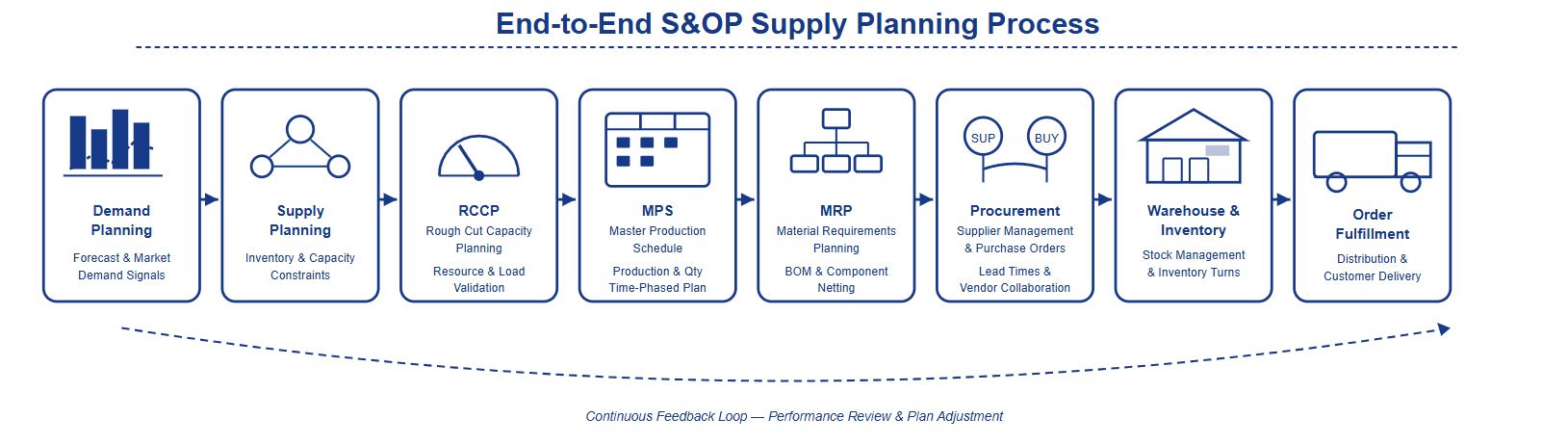
Why Supply Planning Is the Make-or-Break of S&OP
S&OP works best when demand and supply speak the same language. Demand planning captures customer needs and market signals, but it’s the supply plan that determines feasibility. Can we source the materials? Do we have enough capacity? What are the trade-offs between cost, service, and risk?
When supply planning falls short, the consequences ripple across the business — excess inventory ties up working capital, stockouts damage customer trust, and last-minute expediting eats into margins. A strong supply plan doesn’t just keep operations running; it gives leadership the clarity to make better strategic decisions.
How OptiFlowAI Transforms Supply Planning
OptiFlowAI brings intelligence, speed, and visibility to every stage of supply planning within the S&OP cycle. Here’s what it delivers:
Demand-Supply Alignment in Real Time
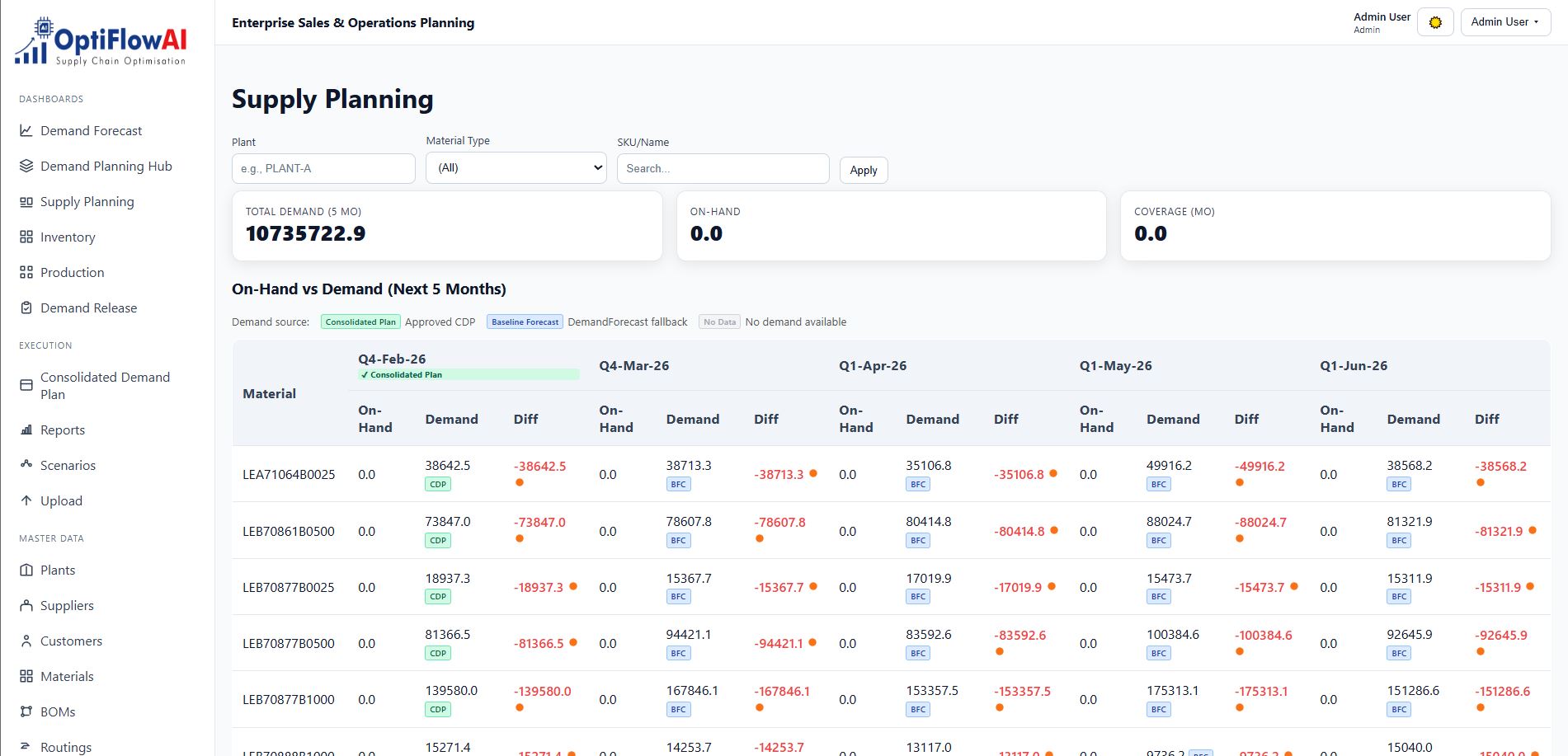
Traditional S&OP processes rely on monthly snapshots that are often outdated before the meeting ends. OptiFlowAI continuously ingests demand signals and maps them against live capacity, inventory positions, and supplier lead times. Key capabilities include:
-
- Continuous synchronization of demand forecasts with supply capacity
-
- Live visibility into inventory positions across all nodes
-
- Automated alerts when demand-supply gaps exceed defined thresholds
-
- A single source of truth that eliminates version-control chaos
Constraint-Aware Scenario Planning
Every supply plan involves trade-offs. OptiFlowAI makes those trade-offs visible and actionable:
-
- Run multiple what-if scenarios in seconds adjusting for capacity shifts, supplier disruptions, or demand spikes
-
- Compare scenarios side by side on cost, service level, and risk exposure
-
- Model the impact of adding shifts, alternate suppliers, or inventory reallocation
-
- Move from hours of spreadsheet modeling to instant, data-driven decision support
AI-Driven Risk Sensing
Disruptions don’t wait for the next planning cycle. OptiFlowAI shifts supply planning from reactive to proactive:
-
- Machine learning monitors supplier performance patterns and logistics variability
-
- Early warning flags give planners weeks of lead time to adjust before issues escalate
-
- Risk scores are embedded directly into the supply plan for transparent prioritization
Intelligent Inventory Optimization
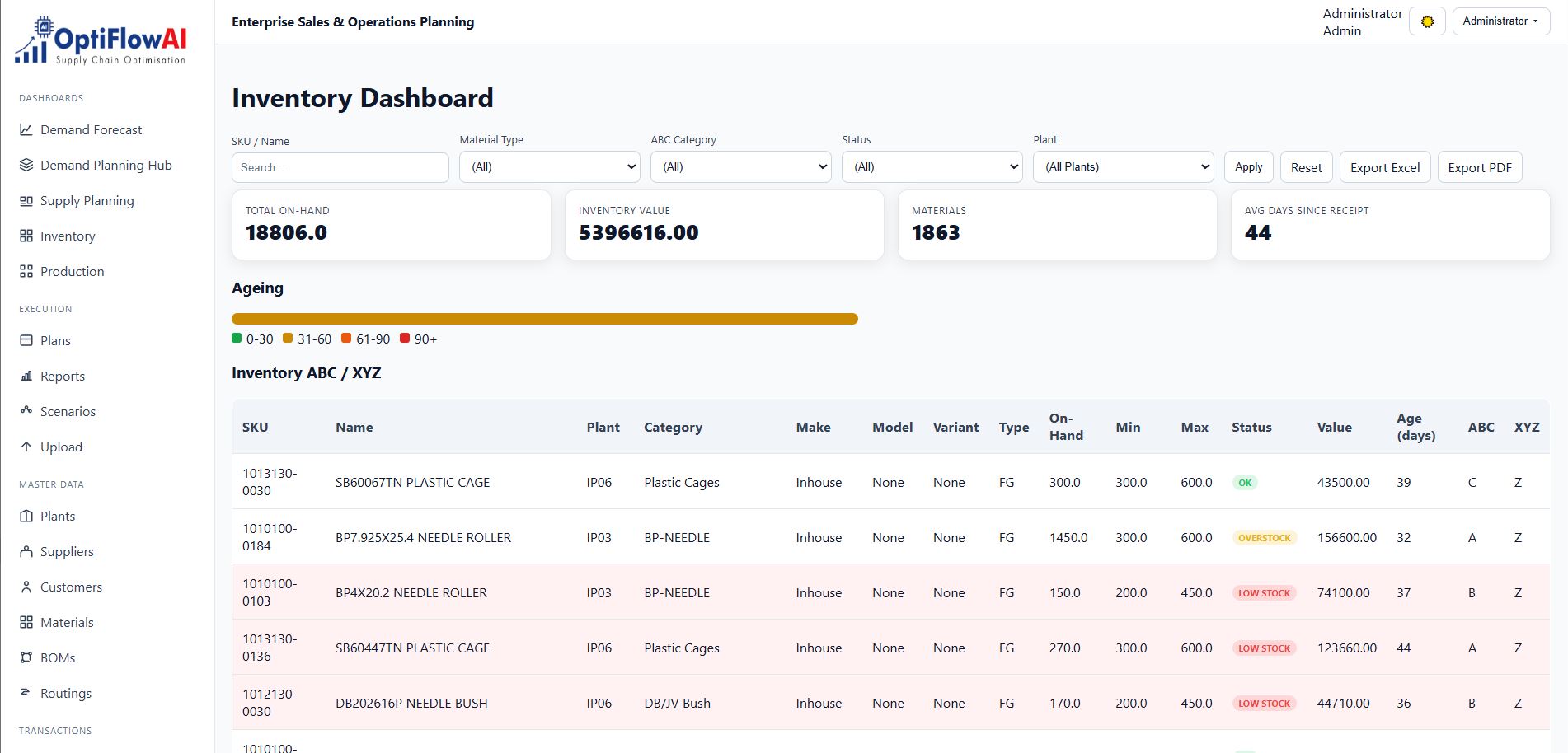
Carrying too much inventory is expensive. Carrying too little is risky. OptiFlowAI finds the sweet spot:
-
- Dynamic safety stock calculations tailored at the SKU level
-
- ABC/XYZ segmentation that adapts as demand patterns evolve
-
- Automated reorder point adjustments based on real-time lead time variability
-
- Lower carrying costs without sacrificing fill rates — a balance most planners struggle to achieve manually
- Lower carrying costs without sacrificing fill rates — a balance most planners struggle to achieve manually
Seamless Cross-Functional Collaboration
S&OP breaks down when supply planning operates in isolation. OptiFlowAI bridges the gap:
-
- A shared workspace where supply, demand, and commercial teams align on one plan
-
- Every stakeholder sees the impact of supply constraints on revenue, margin, and customer commitments
-
- Assumption tracking and annotation so decisions are auditable and transparent
-
- Planning conversations move from “whose spreadsheet is right?” to “which scenario do we commit to?”
The Measurable Impact
Organizations using OptiFlowAI for supply planning within their S&OP process are seeing tangible results improved on-time-in-full delivery, significant reductions in excess and obsolete inventory, higher capacity utilization, and faster planning cycles that free teams to focus on exceptions rather than data wrangling.
More importantly, supply planning becomes a strategic lever rather than an operational chore. When leadership sees demand, supply, inventory, and financial impact in one place, decisions get sharper and execution gets tighter.
Looking Ahead
The future of supply planning is autonomous, continuous, and deeply integrated with the broader business. OptiFlowAI is designed for that future where routine decisions are handled by AI, planners focus on high-value judgment calls, and the S&OP process adapts in real time instead of waiting for the next monthly cycle.
If your supply planning still lives in disconnected spreadsheets and static reports, it’s time to rethink. OptiFlowAI gives your S&OP process the intelligent supply planning engine it deserves.