
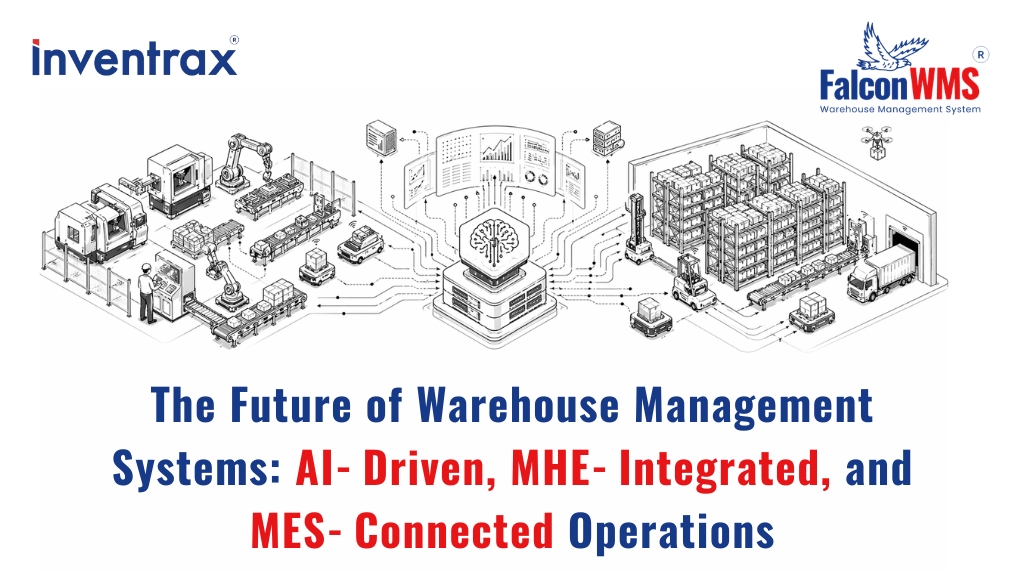
In today’s hyper‑competitive supply chain environment, Warehouse Management Systems (WMS) are no longer just inventory trackers. They are becoming intelligent orchestration platforms that connect manufacturing, material handling, and distribution into one synchronized, real‑time operation.
Modern WMS solutions now combine Artificial Intelligence (AI), semi‑automatic and automatic Material Handling Equipment (MHEs), dock management, and real‑time demand‑based dispatching driven by Manufacturing Execution Systems (MES). This convergence is redefining how warehouses operate—making them faster, smarter, and more resilient.
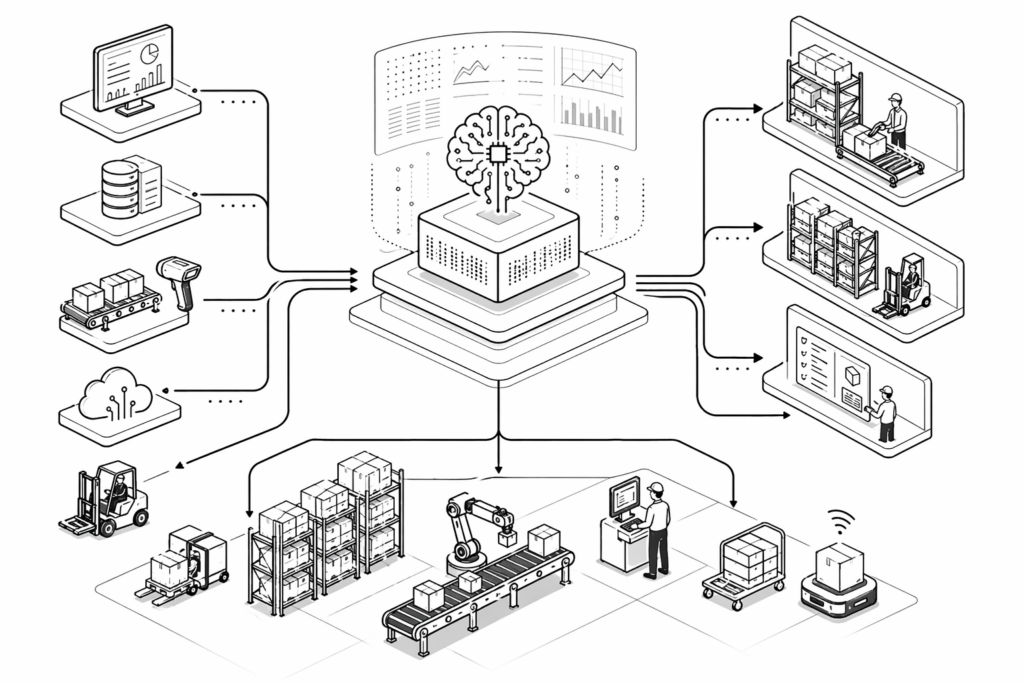
From Traditional WMS to Intelligent Execution Platforms
Traditional WMS primarily focused on:
- Stock records and bin locations
- Putaway and picking rules
- FIFO/FEFO compliance
- Basic reporting
While these functions are still essential, they are no longer sufficient. Warehouses today must respond instantly to:
- Volatile demand
- Shorter production cycles
- Dynamic work orders from factories
- Labor shortages and rising costs
This has led to the emergence of AI‑enabled WMS platforms that actively sense, decide, and act in real time.
AI in WMS: Turning Data into Decisions
Artificial Intelligence adds a decision‑making layer on top of execution.
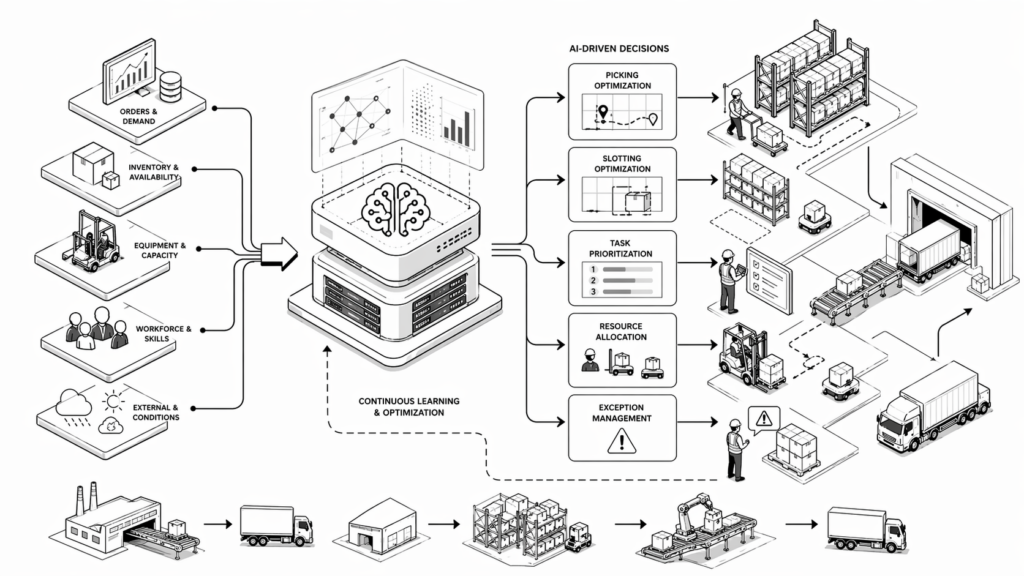
Key AI Capabilities in Modern WMS
1. Predictive Slotting and Re‑Slotting
AI analyzes order history, velocity, seasonality, and SKU affinity to:
- Optimize storage locations
- Reduce travel distance
- Continuously re‑slot based on changing demand
2. Intelligent Task Prioritization
Instead of static rules, AI dynamically prioritizes tasks by:
- Order urgency
- Dock congestion
- Labor and equipment availability
3. Demand‑Based Dispatching
AI engines match real‑time demand signals with inventory, equipment, and workflow capacity—ensuring the right goods move at the right time.
4. Exception Prediction
AI identifies potential delays before they happen:
- Missed cut‑off risks
- Equipment congestion
- Order surges from MES
The result is a WMS that reacts proactively, not just operationally.
Integration with Semi‑Automatic and Automatic MHEs
Material Handling Equipment is no longer peripheral—it is central to warehouse execution.
Semi‑Automatic MHE Integration
Examples include:
- Conveyors
- Pick‑to‑light / put‑to‑light
- VLMs (Vertical Lift Modules)
- Assisted forklifts
The WMS:
- Sends task commands
- Balances loads across equipment
- Adjusts flows based on throughput
Fully Automatic MHE Integration
For high‑volume or manufacturing‑linked warehouses, integration extends to:
- AS/RS systems
- AGVs and AMRs
- Robotic picking and palletizing
- Sortation systems
The WMS acts as the orchestration brain, coordinating:
- Machine priorities
- Buffer management
- Exception handling
- Energy efficiency
AI‑driven logic ensures maximum throughput with minimal manual intervention.
Dock Management: The Missing Link in Warehouse Efficiency
Dock congestion remains one of the most common warehouse bottlenecks. Modern WMS platforms now embed advanced Dock Management Systems (DMS).
Intelligent Dock Capabilities
- Dynamic Dock Assignment based on SKU type, carrier, order priority, and MHE availability
- Real‑Time Yard Visibility integrated with inbound and outbound schedules
- Dock Door Load Balancing to avoid congestion and idle time
- Cross‑Dock Optimization for fast‑moving and production‑linked materials
When dock management is integrated with WMS and MHEs, goods flow seamlessly from truck to storage, production, or dispatch.
Real‑Time Demand‑Based Dispatch Driven by MES
One of the most powerful advancements is the tight integration between WMS and MES.
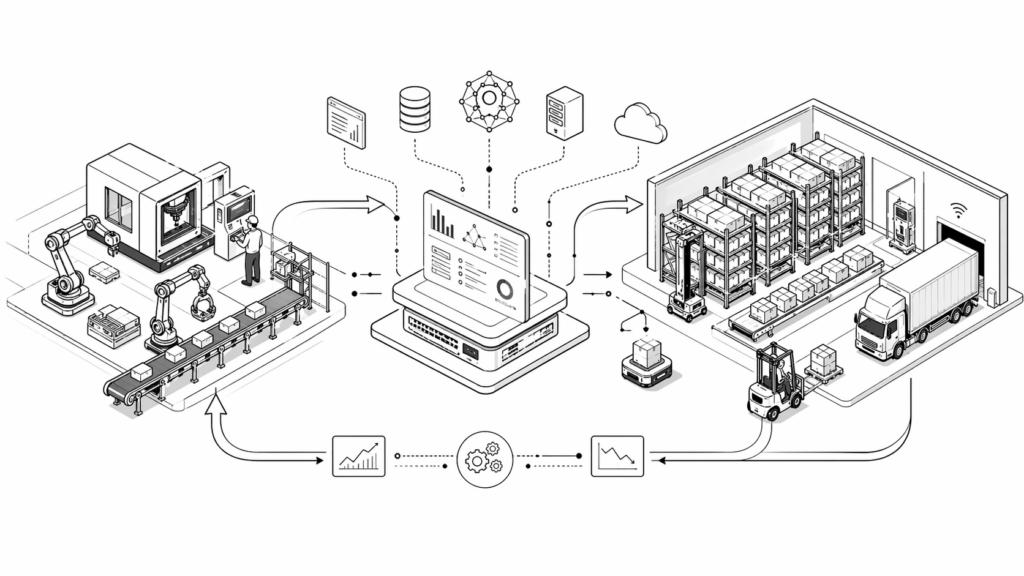
How MES‑Driven Dispatch Works
- MES releases a production work order
- Quantity
- Sequence
- Timing
- Bill of Materials (BOM)
- WMS receives real‑time demand signals
- Raw material requirements
- Finished goods storage needs
- Priority changes from the shop floor
- AI‑Driven WMS Executes Dynamically
- Allocates inventory instantly
- Adjusts picking batches
- Assigns tasks to MHEs
- Schedules dock movements
- Closed‑Loop Feedback
- WMS confirms material delivery
- MES updates production status
- Exceptions are resolved automatically
This real‑time synchronization eliminates:
- Manual material calls
- Buffer overstocking
- Line stoppages
- Dispatch delays
Benefits of an AI‑Enabled, MES‑Integrated WMS
Organizations adopting this architecture achieve measurable gains:
- Higher Throughput with the same or fewer resources
- Reduced Inventory Holding Costs through just‑in‑time movement
- Improved On‑Time Dispatch Performance
- Lower Dependency on Manual Coordination
- Greater Resilience to Demand Volatility
Most importantly, warehouses evolve from cost centers into strategic execution hubs.
The Road Ahead: Autonomous, Self‑Optimizing Warehouses
The future WMS is:
- Self‑learning
- Event‑driven
- Fully integrated across manufacturing and logistics
- Capable of autonomous decision‑making
As AI, MHE automation, dock intelligence, and MES orchestration continue to converge, warehouses will no longer “manage” inventory—they will orchestrate supply chains in real time.