
Every supply plan looks good on the day it’s approved. The demand numbers are aligned, capacity checks out, procurement timelines hold, and inventory targets make sense. Then a key supplier misses a delivery window. Or a tariff announcement reshapes landed costs overnight. Or a customer accelerates an order by three weeks. Suddenly, the plan that passed every review is the plan that can’t respond.
This is the reality most S&OP teams live in a process built around one plan, tested against zero alternatives. OptiFlowAI is built to change that.
THE COST OF PLANNING WITHOUT SCENARIOS
Most organizations treat what-if scenario planning as a luxury something they’ll get to after the base plan is locked. But the most likely version of the future almost never plays out exactly as modelled. Demand shifts. Suppliers slip. Capacity goes offline.
When reality deviates from the plan, the consequences are predictable:
- Rushed reallocations and emergency procurement that erode margins
- Overtime authorizations and expediting costs that nobody budgeted for
- Leadership approving plans without understanding the trade-offs between alternatives
- S&OP meetings that validate a single plan instead of choosing between well-modelled options
WHY SPREADSHEETS CAN’T SOLVE THIS
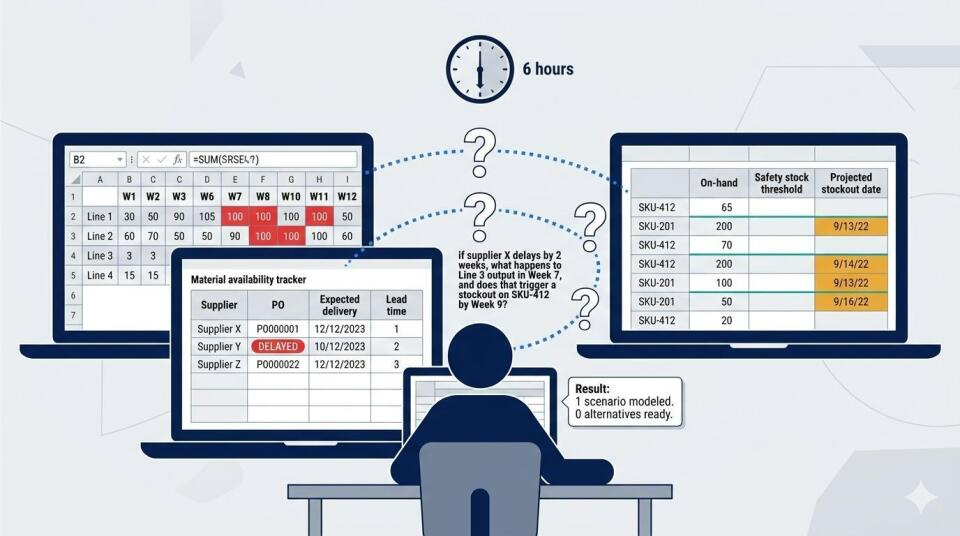
Planners want to run scenarios. The tools won’t let them. Modelling even one alternative in a spreadsheet adjusting capacity, recalculating material availability, rebalancing inventory, projecting financial impact can take hours. The planning cycle simply doesn’t have enough days. So, planners default to experience and instinct:
- One plan gets built; a few risks get flagged in the review meeting
- The what-if question gets asked in every S&OP meeting but almost never answered with data
- Decision-makers are left choosing between a single recommendation and their own gut feel
- The business absorbs the cost of surprises it could have simulated in advance
HOW OPTIFLOWAI CHANGES THE EQUATION
OptiFlowAI was designed to make scenario planning fast, structured, and embedded in every supply decision not bolted on as an afterthought.
Instant Scenario Generation
OptiFlowAI lets planners create and compare multiple supply scenarios in minutes, not days:
- Adjust a supplier lead time, shift a capacity constraint, or change a demand assumption
- The platform recalculates the entire supply plan across materials, production, inventory, and logistics in real time
- Three scenarios before lunch is no longer aspirational it’s routine
Constraint-Aware Modelling
Every scenario OptiFlowAI generates respects real-world constraints:
- Capacity limits, working calendars, and material availability are factored into every simulation
- Minimum order quantities, lead times, and supplier commitments are never ignored
- Planners model against the same rules the shop floor operates under not in a vacuum
Trade-Off Visibility
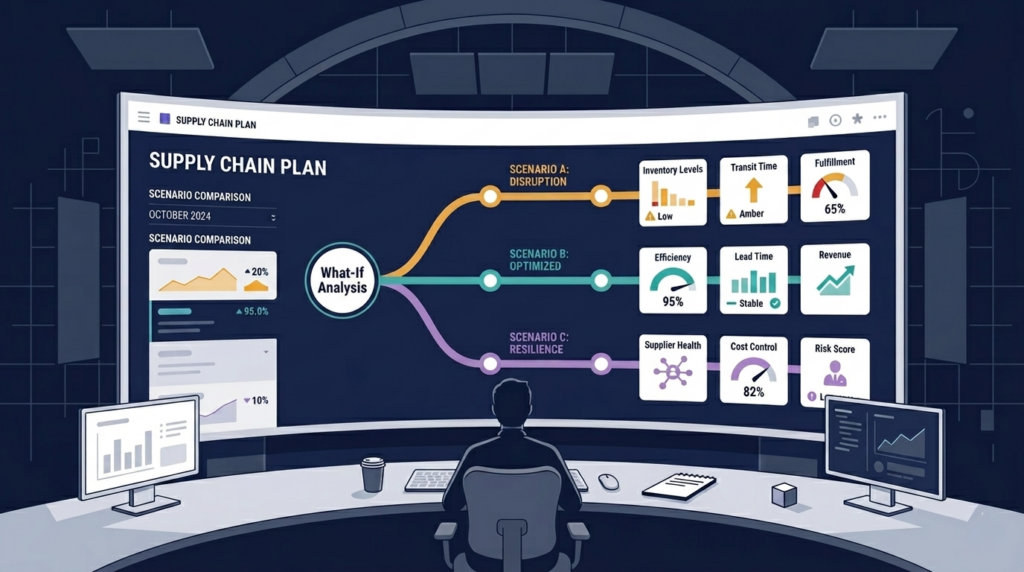
Each scenario surfaces clear trade-offs across cost, service level, inventory impact, and risk exposure:
- Leadership sees options ranked, quantified, and ready for a decision
- “Add a second shift at 12% higher cost, or pull forward procurement at 8% higher carrying cost” that level of clarity transforms S&OP from a status update into a strategy session
- Planning conversations shift from “is this plan, right?” to “which plan best fits our priorities this quarter?”
Disruption Simulation
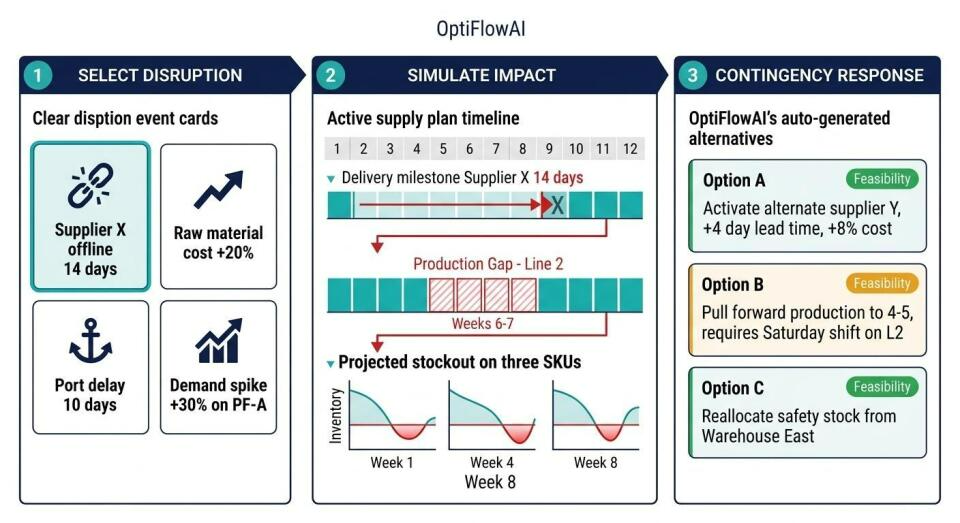
What happens if a critical supplier goes offline for two weeks? What if raw material costs spike 20%? What if a new tariff hits a key import corridor?
- Simulate disruptions before they happen stress-testing the plan against realistic shocks
- Build contingency responses in advance so the playbook exists before the disruption arrives
- Reduce response time from weeks of firefighting to hours of executing a pre-modelled plan
Continuous Scenario Refresh
Scenarios in OptiFlowAI aren’t static snapshots locked to the monthly cycle:
- As demand signals shift and supply conditions change, existing scenarios update automatically
- The what-if analysis stays current decisions made on Tuesday still hold by Friday
- No more presenting stale scenarios in next month’s S&OP review
THE STRATEGIC SHIFT — AND WHY OPTIFLOWAI IS BUILT FOR IT
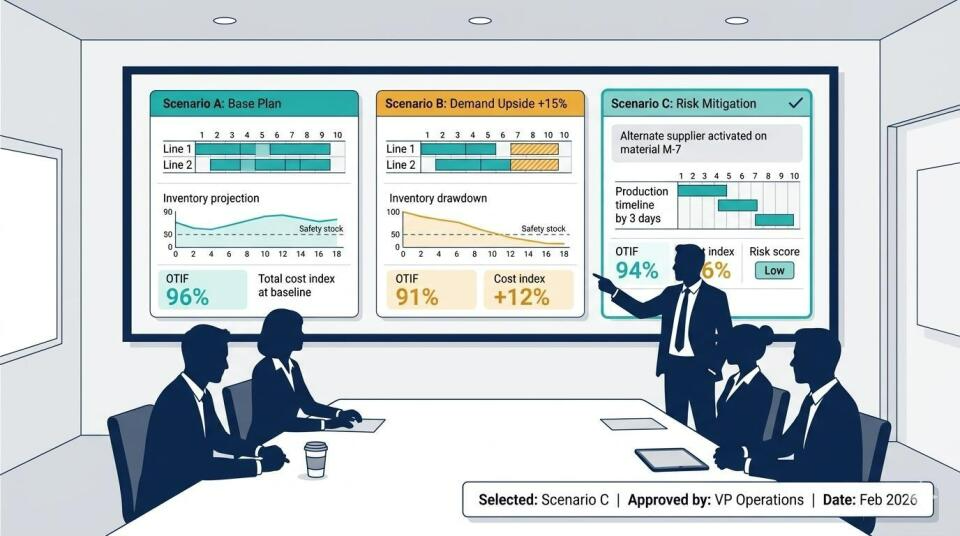
When every supply decision is scenario-tested, something fundamental changes in the S&OP process. Planning moves from a single-track approval exercise to a multi-option decision framework. Leadership stops asking “is this plan, right?” and starts asking “which plan best fits our priorities this quarter?”
OptiFlowAI was purpose-built for this shift. It doesn’t treat scenario planning as an add-on module or a premium feature — it’s woven into every layer of the platform. From demand review to supply commitment to executive sign-off, every step in OptiFlowAI runs through a scenario lens. The result is an S&OP process where no plan goes unquestioned, no constraint goes unmodeled, and no decision is made on a single version of the future.
With OptiFlowAI, the question is never “what if something changes?” — it’s “which response have we already modelled?