
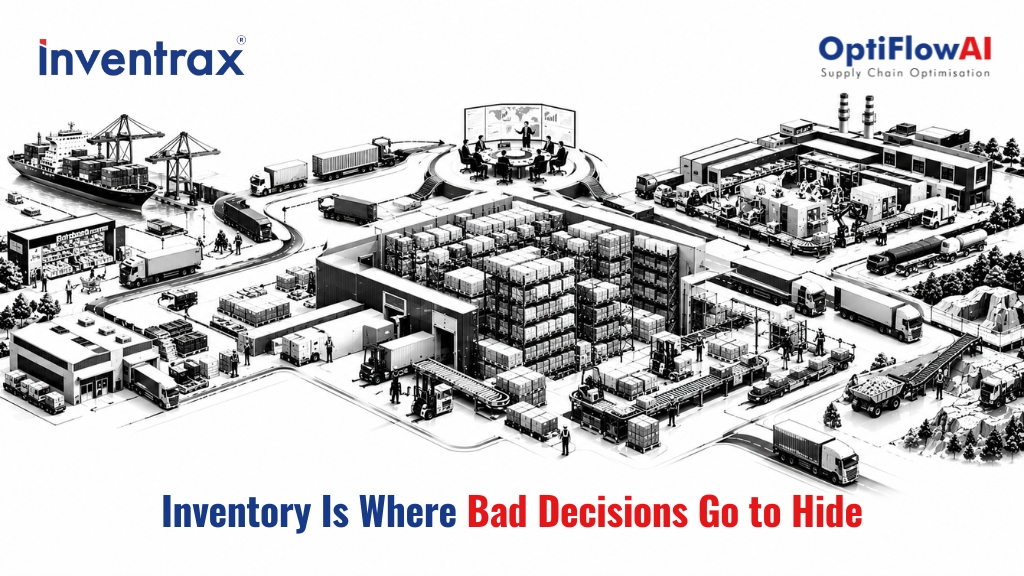
Too Much Inventory Looks Like a Warehouse Problem. But It Usually Starts With Planning.
Too much inventory looks like a warehouse problem. Too little looks like a customer-service problem. Finance calls it a working capital problem. Operations calls it a supplier problem. Everyone sees a different symptom, and almost nobody traces it back to where it actually started: a planning decision that was never really made, just deferred until inventory absorbed it.
That’s the uncomfortable truth about inventory in most organizations. It isn’t usually a warehouse issue. It’s where unresolved disagreements between sales, purchasing, operations, and finance quietly come to rest.
The Buffer for Everything Nobody Agreed On
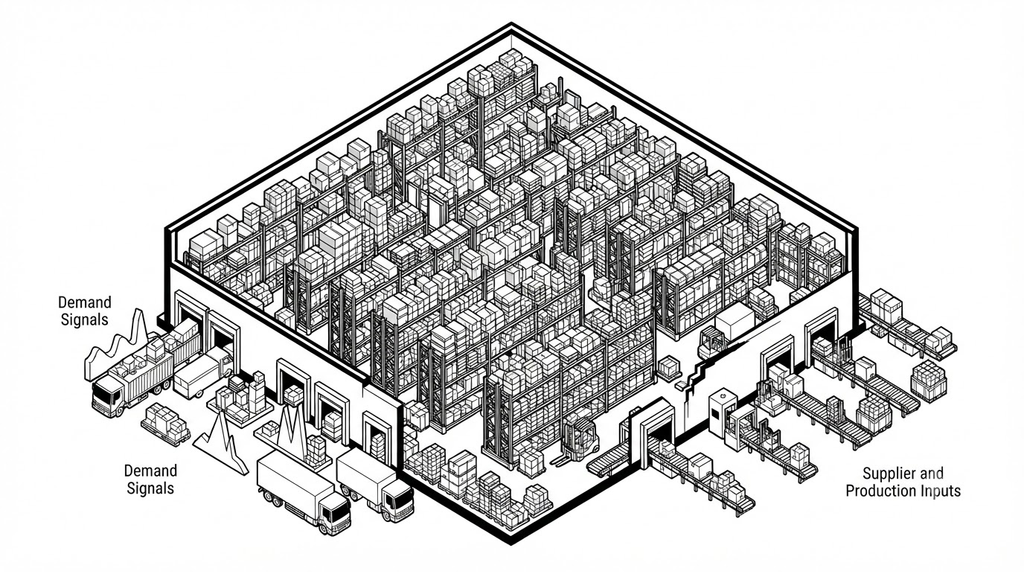
When sales forecasts, purchasing decisions, supplier lead times, and financial targets are disconnected, something still has to absorb the gap between what was expected and what actually happens. That something is inventory.
As TechTarget’s analysis of S&OP inventory metrics puts it, in most companies inventory acts as a decoupling point that absorbs the differences between the cycles, quantities, and timing of supply and demand. The inventory level isn’t a primary objective of planning. It’s an output, a measurement of how well, or how poorly, the supply and demand plan actually came together.
When that plan is built on disconnected inputs, inventory doesn’t fail loudly. It just grows, quietly, as a hedge against the uncertainty nobody resolved.
A 2025 ABI Research survey found that 71% of businesses cite a lack of clear planning processes as a major blocker to decision-making. Netstock’s 2026 benchmark data shows the pattern playing out in real numbers: 30% of SMBs now report that more than 30% of their excess stock is deliberately held as a strategic buffer, up from 23% the year before. That’s not a declining trend. Organizations are leaning harder on inventory to compensate for planning gaps, not less.
Why This Is Harder to Diagnose Than It Sounds
The difficulty with inventory-as-symptom is that every function sees a different piece of it, and each piece looks like a legitimate, self-contained problem.
Sales sees stockouts and assumes purchasing isn’t ordering enough. Purchasing sees excess stock and assumes sales forecasts are inflated. Finance sees working capital tied up and assumes operations is overbuying. Operations sees supplier delays and assumes nobody accounted for lead time risk. Each team is responding to something real. None of them is looking at the actual root cause, because the root cause isn’t visible from any single function’s seat.
A large, static buffer makes this worse, not better. It can mask demand shifts until the mismatch is severe enough to cause a sudden stockout or a forced liquidation. The buffer was supposed to protect against uncertainty. Instead, it hid the fact that the underlying forecast had drifted from reality months earlier, because nobody was watching for it.
This is also why inventory problems tend to resist simple fixes. Tightening the buffer without fixing what caused it to grow just shifts the pain from excess cost to stockout risk. Loosening it doesn’t address why the gap existed in the first place. Either move treats the symptom, not the disconnect between functions that created it.
What Good S&OP Is Actually For
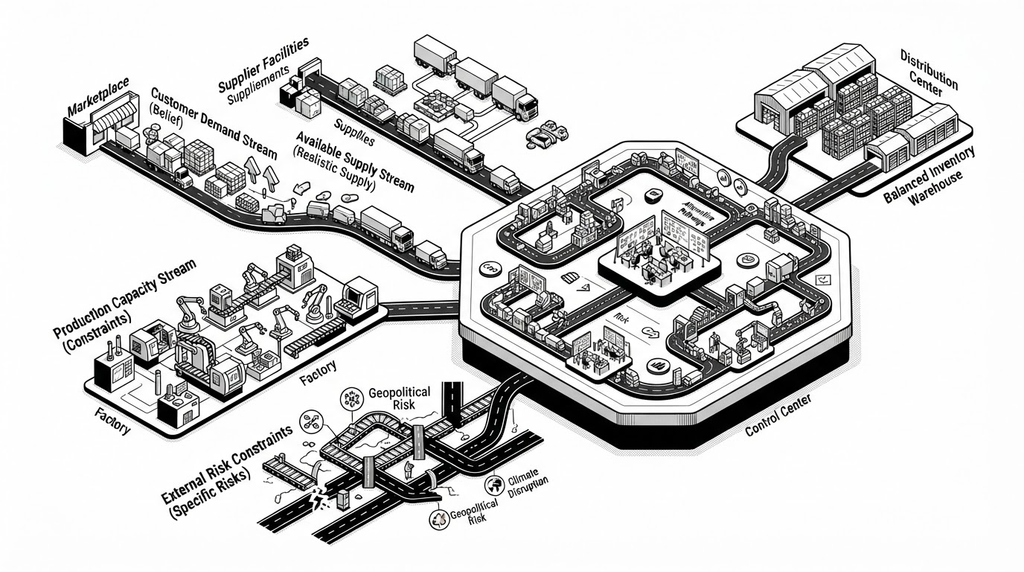
This is the real argument for S&OP, and it’s a narrower, more specific claim than most people assume. S&OP isn’t primarily about producing a forecast. It’s about forcing a small set of decisions that nobody can keep deferring:
- What demand does the business actually believe, not what sales wants to believe or what finance needs to believe for the budget to work
- What can the business realistically supply, given actual capacity and actual supplier performance, not theoretical capacity
- Where are the specific risks, named and owned, not a generic acknowledgment that “things could go wrong”
- What trade-offs is the business prepared to make when demand and supply don’t match, decided in advance rather than improvised during the crisis
Netstock’s research describes this shift precisely: the movement from firefighting to proactive planning, turning data into a small set of viable options that leadership can act on with confidence. That’s a different goal than chasing forecast accuracy. A forecast will never be perfect, and chasing precision past a certain point is wasted effort. What actually changes outcomes is fewer surprises, earlier decisions, and alignment across functions before the gap shows up as inventory.
The Signal That Something Is Working
There’s a useful test for whether an organization’s planning process is actually functioning, separate from whether the forecast was accurate. Ask where the trade-off decisions get made.
If every demand-supply mismatch gets resolved silently through inventory, the planning process isn’t really deciding anything. It’s deferring every hard call to whichever function ends up holding the consequence, usually the warehouse or the balance sheet. If trade-offs get made explicitly, in a review where sales, operations, and finance look at the same numbers and choose a response together, inventory stops being a dumping ground and starts being what it was always supposed to be: a deliberate, sized buffer against a specific, named risk.
How OptiFlowAI Prevents Inventory From Becoming the Dumping Ground
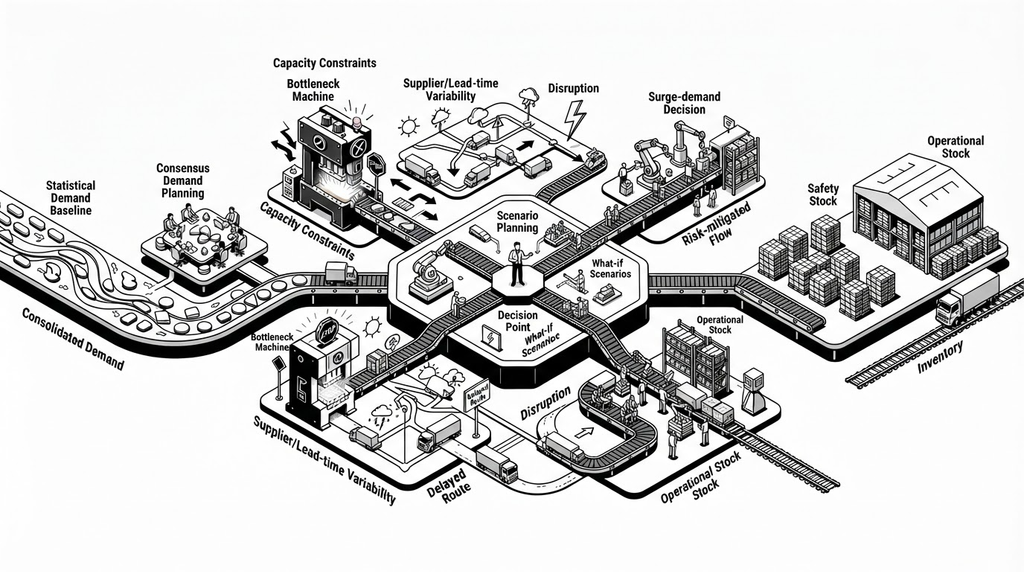
Most planning tools treat demand, supply, capacity, and inventory as separate modules that get reconciled manually, usually in a spreadsheet, usually too late to change anything. OptiFlowAI is built so the four decisions a real S&OP process should force are visible together, before inventory has to absorb whatever didn’t get resolved.
What Demand Does the Business Actually Believe
The Consolidated Demand Plan runs on two tiers, a statistical baseline forecast and a consensus plan built on top of it, so the number going into supply planning isn’t just an algorithm’s guess. It’s the number cross-functional teams actually agreed to stand behind, with the override and the reasoning both visible.
What Can the Business Realistically Supply
Capacity isn’t checked after the demand plan is finalized, it’s checked as part of it. The RCCP-to-FCP bridge rolls aggregate capacity checks down into daily, finite scheduling constraints, so a plan doesn’t get approved on paper and then fail on the shop floor three weeks later.
- Capacity gaps surface at the planning stage, not at the production stage
- Safety stock operates on combined demand and lead time variability, not a static number set once and left untouched
Where Are the Risks
External risk signals, supplier delays, logistics disruptions, geopolitical events, map directly to the constraints and demand adjustments they affect, and a planner validates the impact before it silently reshapes the plan. Risk doesn’t stay a vague line item in a review deck. It attaches to the specific part of the plan it threatens.
What Trade-Offs Is the Business Prepared to Make
What-if scenario planning and surge demand absorption run on the same incremental impact simulation engine, so a trade-off decision, add a shift, pull forward a PO, accept a lower service level on one SKU, gets modeled and compared before it’s chosen, not improvised during a stockout.
Inventory stops being where unresolved decisions go to hide when the decisions get made somewhere else first, visibly, with the trade-offs on the table. That’s the gap OptiFlowAI is built to close, not a better inventory number, but a planning process that doesn’t need inventory to cover for what it failed to decide.