
Introduction
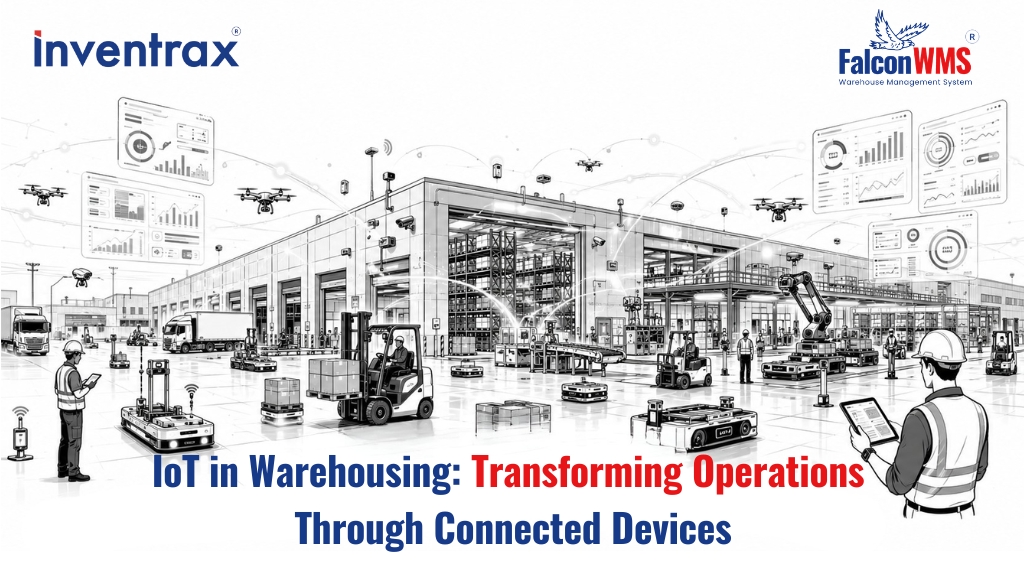
The modern warehouse is rapidly evolving from a traditional storage facility into an intelligent, connected ecosystem. As businesses strive to meet increasing customer demands, improve operational efficiency, and gain real-time visibility, the Internet of Things (IoT) has emerged as a key driver of warehouse transformation.
IoT enables warehouses to connect people, equipment, inventory, and infrastructure through smart devices and sensors that continuously collect and exchange data. This real-time information empowers organizations to make informed decisions, automate routine processes, and optimize warehouse performance.
In this blog, we explore how IoT is reshaping warehouse operations, its key applications, benefits, implementation challenges, and why it is becoming an essential component of the modern supply chain.
What is IoT in Warehousing?
The Internet of Things (IoT) refers to a network of physical devices embedded with sensors, software, and communication technologies that enable them to collect, transmit, and analyze data over the internet or private networks.
In a warehouse environment, IoT connects various assets, including:
- Inventory
- Pallets and containers
- Material handling equipment
- Forklifts
- Conveyor systems
- Automated Guided Vehicles (AGVs)
- Autonomous Mobile Robots (AMRs)
- Warehouse infrastructure
- Environmental sensors
- Wearable devices
These connected devices provide continuous visibility into warehouse operations, enabling businesses to monitor activities, identify issues proactively, and improve overall efficiency.
Why IoT Matters in Modern Warehousing
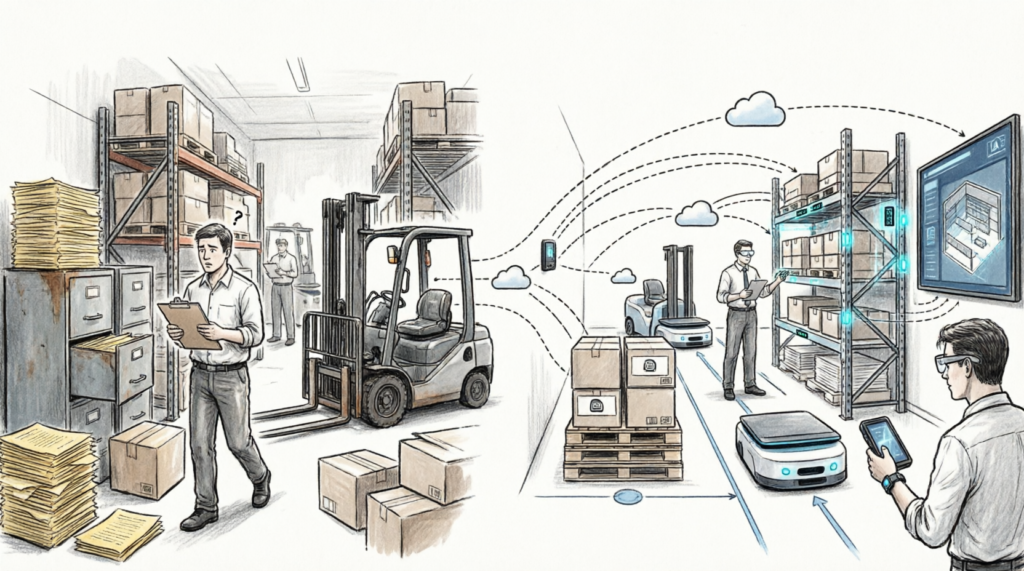
Traditional warehouse operations often rely on manual data collection and periodic updates, which can lead to delays, inaccuracies, and limited visibility.
IoT eliminates these gaps by providing:
- Real-time operational insights
- Continuous inventory tracking
- Predictive maintenance
- Automated alerts
- Intelligent decision-making
- Enhanced worker safety
By turning physical warehouse assets into connected, data-generating devices, IoT helps organizations operate more efficiently and respond quickly to changing business demands.
Key Applications of IoT in Warehousing
1. Real-Time Inventory Tracking
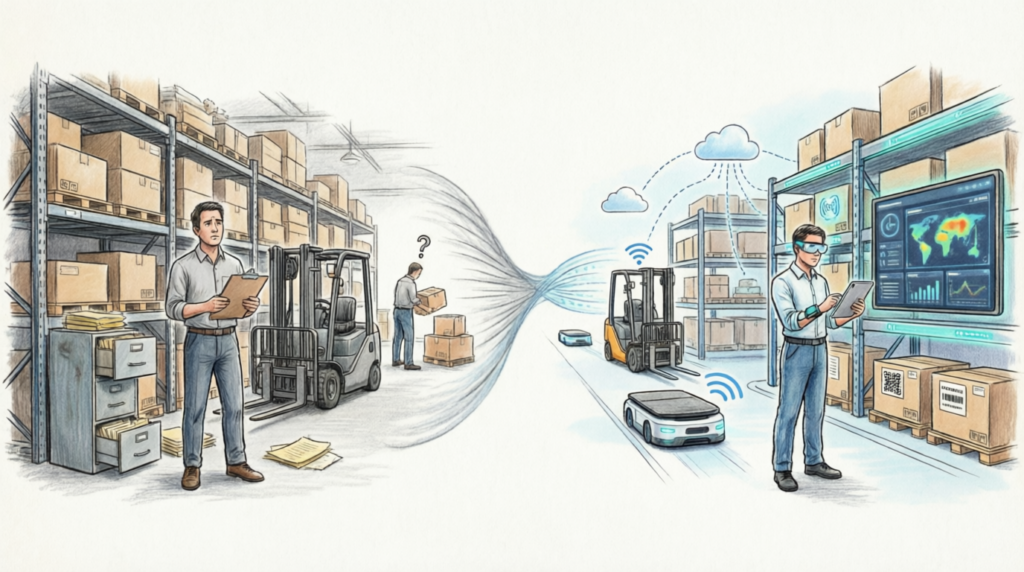
One of the most valuable applications of IoT is continuous inventory visibility.
Using RFID tags, smart sensors, and connected barcode scanners, warehouses can monitor inventory movement in real time.
Benefits include:
- Accurate inventory records
- Faster stock locating
- Reduced inventory loss
- Improved order fulfillment
- Better inventory planning
Managers always know where inventory is located and its current status.
2. Smart Asset Tracking
Warehouses often manage expensive assets such as:
- Forklifts
- Pallet jacks
- Trolleys
- Returnable containers
- Mobile scanners
- Automated equipment
IoT-enabled tracking devices provide real-time location information, reducing equipment loss and improving utilization.
3. Predictive Maintenance
Unexpected equipment failures can significantly impact warehouse productivity.
IoT sensors continuously monitor equipment parameters such as:
- Temperature
- Vibration
- Motor performance
- Energy consumption
- Operating hours
When abnormalities are detected, maintenance teams receive alerts before equipment fails, minimizing downtime and reducing repair costs.
4. Environmental Monitoring
Many industries require strict environmental control, including:
- Pharmaceuticals
- Food & Beverage
- Chemicals
- Healthcare
IoT sensors monitor:
- Temperature
- Humidity
- Air quality
- Light exposure
If conditions exceed acceptable thresholds, automatic alerts enable immediate corrective action, protecting sensitive inventory and ensuring regulatory compliance.
5. Worker Safety
Connected wearable devices enhance employee safety by monitoring:
- Worker location
- Fatigue levels
- Emergency situations
- Restricted area access
Wearables can also detect falls or accidents and instantly notify supervisors, improving workplace safety and emergency response times.
6. Smart Energy Management
IoT helps warehouses optimize energy consumption by monitoring:
- Lighting
- HVAC systems
- Charging stations
- Equipment usage
Smart controls automatically adjust energy usage based on occupancy and operational requirements, reducing utility costs and supporting sustainability goals.
7. Connected Material Handling Equipment
Forklifts, conveyors, AGVs, and AMRs equipped with IoT sensors continuously report:
- Operational status
- Battery levels
- Utilization rates
- Travel paths
- Performance metrics
This information enables better resource planning and operational efficiency.
8. Dock and Yard Management
IoT enables better coordination of inbound and outbound logistics by tracking:
- Vehicle arrivals
- Trailer locations
- Dock occupancy
- Loading status
Real-time visibility reduces waiting times, improves scheduling, and enhances dock utilization.
Benefits of IoT in Warehousing
Enhanced Inventory Visibility
Real-time tracking provides complete transparency across the warehouse, helping businesses maintain accurate inventory records and reduce stock discrepancies.
Improved Operational Efficiency
Continuous monitoring enables faster decision-making, reduces manual intervention, and streamlines warehouse processes.
Reduced Equipment Downtime
Predictive maintenance minimizes unexpected breakdowns and extends the lifespan of warehouse equipment.
Better Customer Service
Accurate inventory data and faster order processing help businesses meet customer expectations for timely and error-free deliveries.
Increased Worker Productivity
Employees spend less time searching for inventory or equipment, allowing them to focus on value-added tasks.
Lower Operational Costs
IoT helps reduce costs by minimizing inventory losses, optimizing energy usage, preventing equipment failures, and improving resource utilization.
Data-Driven Decision Making
Warehouse managers can leverage real-time dashboards and analytics to monitor key performance indicators (KPIs), identify bottlenecks, and continuously improve operations.
IoT and Warehouse Management Systems (WMS)
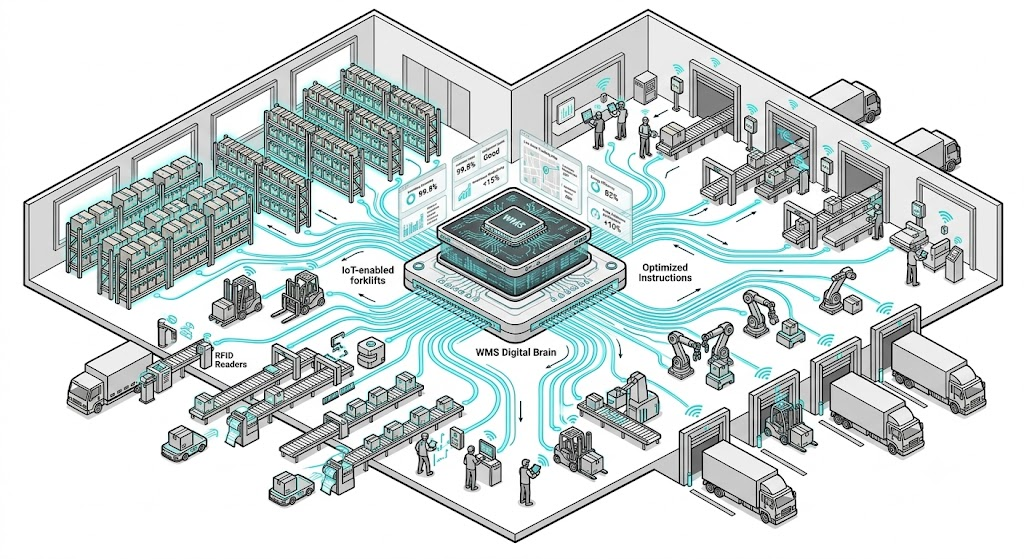
IoT delivers maximum value when integrated with a Warehouse Management System.
The WMS serves as the central platform that receives data from IoT devices and converts it into actionable insights.
Examples include:
- Automatic inventory updates after sensor-based movements
- Real-time location tracking for pallets and equipment
- Automated replenishment triggers
- Equipment status monitoring
- Exception alerts for environmental conditions
- Live dashboards for warehouse managers
The integration of IoT and WMS creates a highly responsive and intelligent warehouse ecosystem.
Challenges of Implementing IoT
Integration Complexity
IoT devices must integrate seamlessly with existing WMS, ERP, and automation systems.
Cybersecurity
Connected devices increase the number of potential entry points for cyber threats. Organizations must implement secure networks, encryption, and access controls.
Data Management
Thousands of connected devices generate large volumes of data. Businesses need robust data storage, analytics, and governance strategies to extract meaningful insights.
Initial Investment
Deploying IoT infrastructure involves investments in sensors, connectivity, software, and integration. However, the long-term operational gains often justify the cost.
Device Maintenance
Sensors and connected devices require periodic calibration, battery replacement, and maintenance to ensure reliable performance.
Best Practices for Successful IoT Adoption
Organizations planning to implement IoT should:
- Identify operational challenges and define measurable objectives.
- Start with a pilot project before scaling across the warehouse.
- Choose devices that support open communication standards.
- Integrate IoT with existing WMS, ERP, and automation systems.
- Implement strong cybersecurity policies and regular monitoring.
- Train employees to effectively use IoT-enabled tools and dashboards.
- Continuously analyze collected data to drive process improvements.
The Future of IoT in Warehousing
IoT continues to evolve alongside advancements in Artificial Intelligence, Machine Learning, 5G connectivity, and edge computing.
Future warehouses will leverage IoT to:
- Enable autonomous decision-making
- Optimize robot collaboration
- Improve demand forecasting
- Support digital twin simulations
- Enhance predictive maintenance
- Increase sustainability through intelligent energy management
As connectivity and analytics become more sophisticated, IoT will play an even greater role in creating agile, resilient, and highly efficient warehouse operations.
Conclusion
The Internet of Things is transforming warehousing by connecting inventory, equipment, infrastructure, and people into a single intelligent ecosystem. With real-time visibility, predictive insights, and automated decision-making, IoT empowers businesses to improve efficiency, reduce costs, enhance safety, and deliver superior customer service.
When combined with a modern Warehouse Management System and automation technologies, IoT becomes a powerful enabler of digital transformation—helping organizations build smarter warehouses that are ready for the demands of the future.
About Inventrax
At Inventrax, we help businesses embrace digital transformation through advanced Warehouse Management Systems (WMS), Warehouse Control Systems (WCS), IoT integration, and warehouse automation solutions. Our expertise enables organizations to build connected, intelligent warehouses that improve operational efficiency, maximize visibility, and support long-term growth.
Ready to connect your warehouse?
Contact us today to discover how IoT-powered warehouse solutions can transform your operations and prepare your business for the future.