

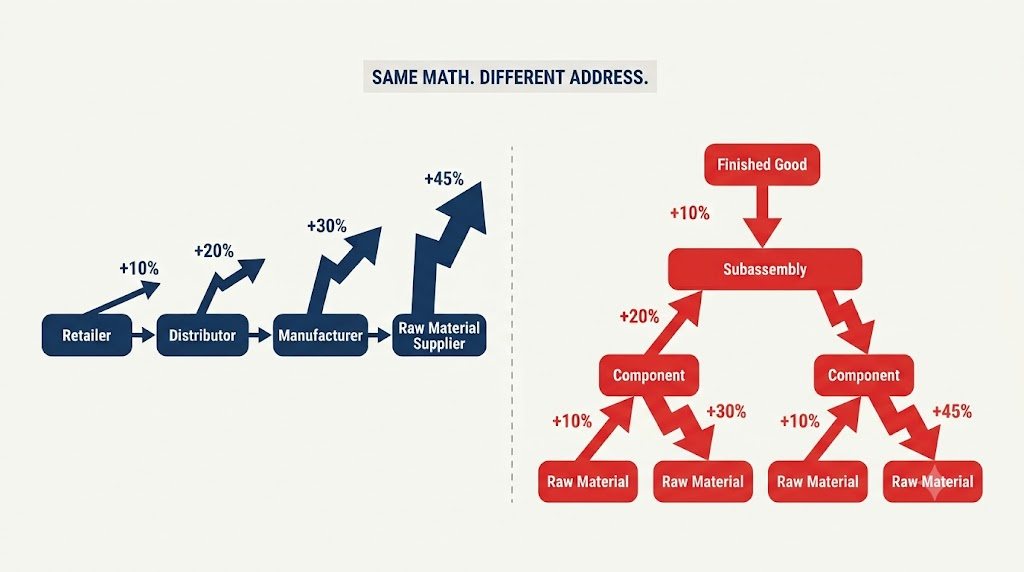
A retailer sees a modest 10% increase in sales. Concerned about running short, they bump their next order up by 20%. The distributor sees that amplified order, gets nervous, and orders 30% more from the manufacturer. By the time the signal reaches raw material suppliers, a 10% shift in actual demand has become a 40-50% swing in production orders.
That’s the bullwhip effect, first documented by Lee, Padmanabhan, and Whang in 1997. What gets far less attention is that the identical mechanism plays out inside a single company, inside a single MRP run, moving down through a bill of materials instead of up through trading partners. Planners have a name for it too. They call it MRP nervousness, and most of them have simply learned to live with it rather than trace it back to its cause.
THE SAME MATH, A DIFFERENT ADDRESS
The bullwhip effect and MRP nervousness share the same underlying mechanism: variance amplification. A small distortion at one point in a chain doesn’t stay small as it propagates. It compounds at every step where a decision gets made based on the previous step’s output rather than the original signal.
Inside an MRP system, that chain is the bill of materials. When top-level item forecasts contain even minor inaccuracies, these errors multiply at lower levels as subassembly usage quantities and lot sizes compound mistakes at successive tiers. Traditional MRP makes this structurally worse rather than better, using safety stock positions and cumulative lead times that cascade through the complete structure and amplify the swings at each level.
- A minor forecast revision at the finished goods level triggers a proportionally larger adjustment at the subassembly level, because lot-sizing rules round the requirement up or down rather than passing it through exactly
- That rounded adjustment compounds further at the component level, where its own lot-sizing and safety stock rules add another layer of distortion
- By the raw material level, a change that started as a small rounding difference can look indistinguishable from a genuine shift in demand
- Suppliers receiving these distorted signals have no way to know whether they’re looking at real demand change or internal system noise
Studies on MRP system nervousness consistently link it to two root causes working together: forecast quality, since more frequent updates interact directly with how often MRP recalculates, and lot-sizing policy, since different rules dampen or amplify instability to very different degrees. Neither cause is exotic. Both are baked into decisions most planning teams made years ago and haven’t revisited since.
WHAT THIS ACTUALLY COSTS
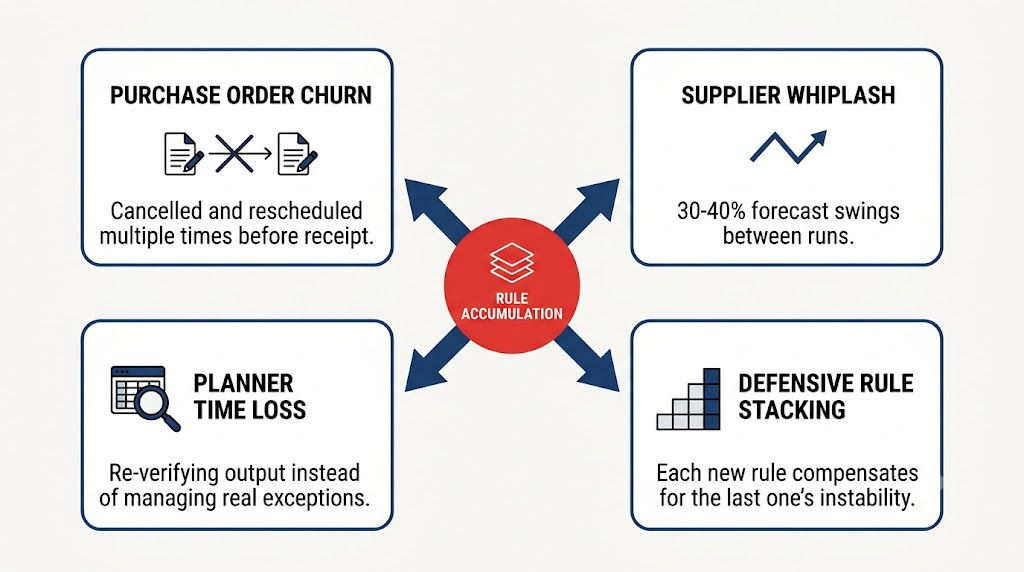
MRP is deterministic by design. In practice, it becomes opaque through years of rule accumulation, lot-sizing rules, buffers, safety stock policies, order multiples, each reasonable when added, stacking into a system where explaining a single output requires walking back through multiple requirement levels and BOM layers. Eventually, most planners stop trying. They react to whatever the system proposes, run after run.
That opacity fans out into a familiar set of downstream symptoms, all sharing the same root cause:
- Purchase orders created, cancelled, and rescheduled multiple times before a single unit is ever received
- Supplier-facing forecasts that swing 30-40% between runs even when actual demand barely moved
- Planners spending a disproportionate share of their time re-verifying system output instead of managing real exceptions
- Safety stock and lot-sizing rules stacked defensively, each one compensating for instability the last rule created
One long-standing response has been freezing the master production schedule, locking a portion of the near-term plan. It works, to a point, but the freezing parameters carry real trade-offs against cost and service level that most organizations never formally analyze. It’s a dampener applied at one point, not a fix for the amplification happening throughout the system.
Demand Driven MRP takes a more structural approach, using decoupling buffers that absorb variability from multiple directions rather than letting it propagate backward through every tier. Whichever methodology an organization chooses, the lesson holds: sustainable gains come from fixing the structure that lets distortion compound, not from adding another rule to manage it after the fact.
HOW OPTIFLOWAI CLOSES THE GAP
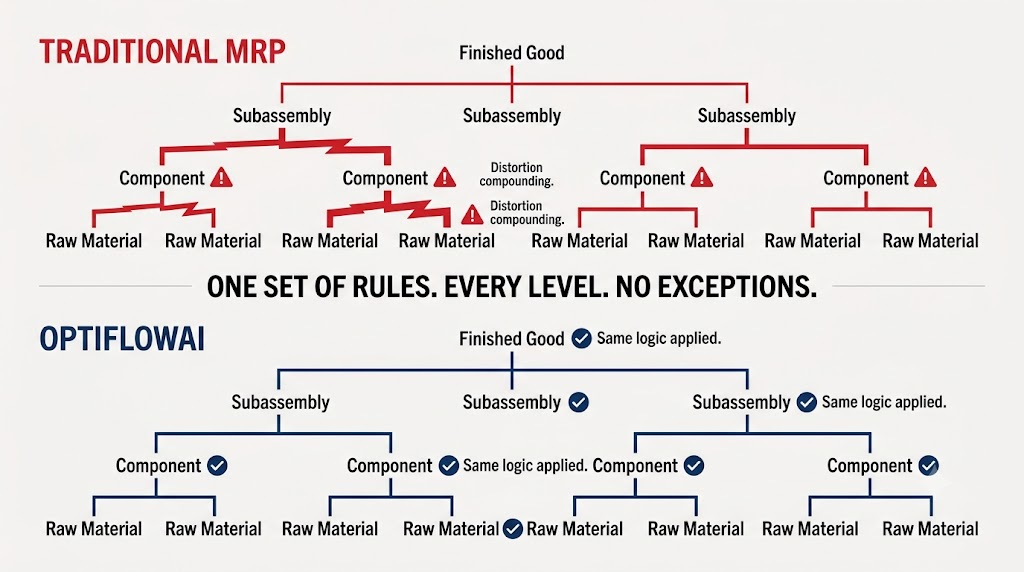
MRP nervousness has one real cause: distortion that compounds through the bill of materials with no visibility into why. OptiFlowAI is built to remove that condition at the source.
One Set of Rules. Every Level. No Exceptions.
OptiFlowAI calculates net requirements using the same logic at every tier of the bill of materials, from finished goods down to raw materials, with no accumulation of SKU-specific overrides that quietly diverge over time. Stable demand produces a stable plan every time, because the math doesn’t change depending on which item or level is being viewed.
Every Number Shows Its Cause
When a requirement changes between planning runs, OptiFlowAI shows what changed underneath it, a demand shift, a lead time update, a stock position change, directly alongside the number itself. Planners see cause and effect on the same screen instead of reconstructing it across disconnected systems.
Safety Stock Reflects Risk, Not Position in the BOM
Safety stock functions as a threshold tied to actual demand variability and lead time risk at each level, not a value that compounds the further a component sits from the finished good. A raw material three tiers down carries protection sized to its own risk profile, not an inflated buffer inherited from amplification upstream.
Real Volatility Gets Through. Artificial Volatility Doesn’t.
Genuine demand shifts should flow through the plan, and they do. What OptiFlowAI eliminates is the volatility the system generates on its own, the swings caused by rule accumulation rather than anything actually happening in the business. That distinction is what separates a planning system a business can trust from one it has to constantly second-guess.