
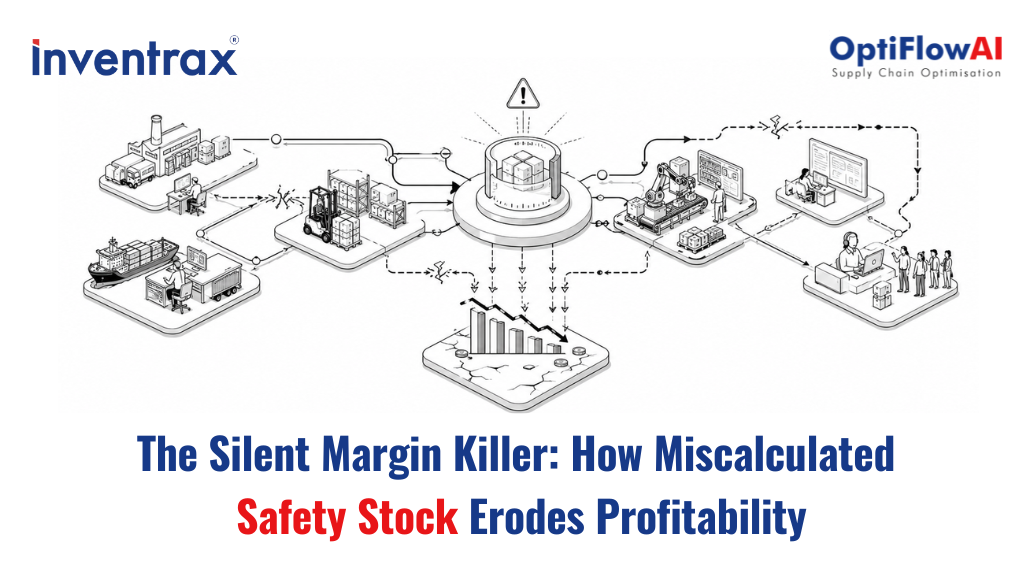
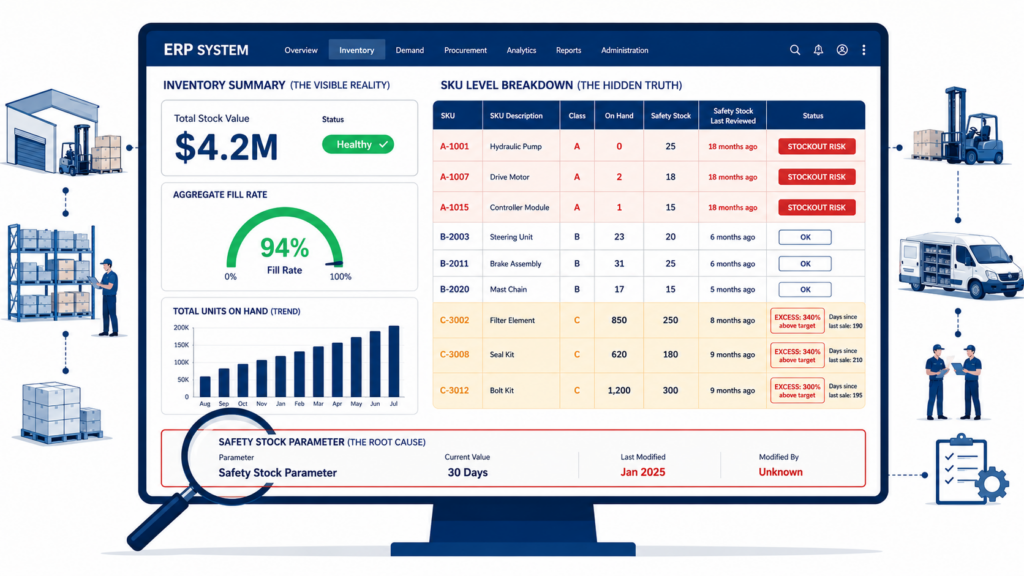
The warehouse is full. The fill rate is dropping. Finance is asking why working capital is locked up in inventory while sales is complaining about stockouts on the SKUs that matter most. The demand forecast hasn’t changed. The suppliers haven’t missed a delivery. Nothing obvious went wrong.
But something did. Quietly. Months ago.
Someone set a safety stock parameter in the ERP. A reasonable number at the time — based on a standard formula, a rough service level target, and an assumption about lead time variability that may or may not have been accurate. That number has been silently governing how MRP generates orders, how the production schedule gets triggered, and how inventory distributes across the network ever since. It hasn’t been reviewed. It hasn’t been challenged. And it’s been wrong just enough — not catastrophically, but persistently — to bleed margin month after month without ever triggering an alarm.
This is the silent margin killer. And almost every supply chain has one.
THE PARAMETER NOBODY OWNS
Safety stock should be one of the most actively managed parameters in supply planning. In practice, it’s one of the most neglected.
- Most values are calculated once during ERP implementation or an annual planning cycle — then never revisited
- Nobody owns the review. Demand planners assume supply planners manage it. Supply planners assume the system handles it. The system holds whatever was entered last.
- Demand variability shifts seasonally. Promotional calendars change the mix. Supplier lead times fluctuate by weeks. But the safety stock parameter sits frozen at last year’s number.
- Industry research estimates carrying costs at 20–30% of total stock value per year. A 10% overestimation across a SKU base can mean millions in avoidable cost annually. A 10% underestimation means stockouts on the highest-value products.
The textbook formula — Z-score × standard deviation of demand × square root of lead time — is still the default in most ERPs. As Lokad’s inventory research bluntly notes, this approach is embedded across most ERPs and MRPs, and it is vastly dysfunctional. It assumes demand and lead times follow normal distributions. In most real supply chains, neither does. It treats every SKU identically. It ignores that all SKUs compete for the same working capital, warehouse space, and procurement bandwidth. And it gives planners a false sense of precision while delivering a paradox they can’t explain: high inventory and low availability in the same warehouse.
THE SOLUTIONS THAT SHOULD HAVE FIXED THIS — AND HAVEN’T
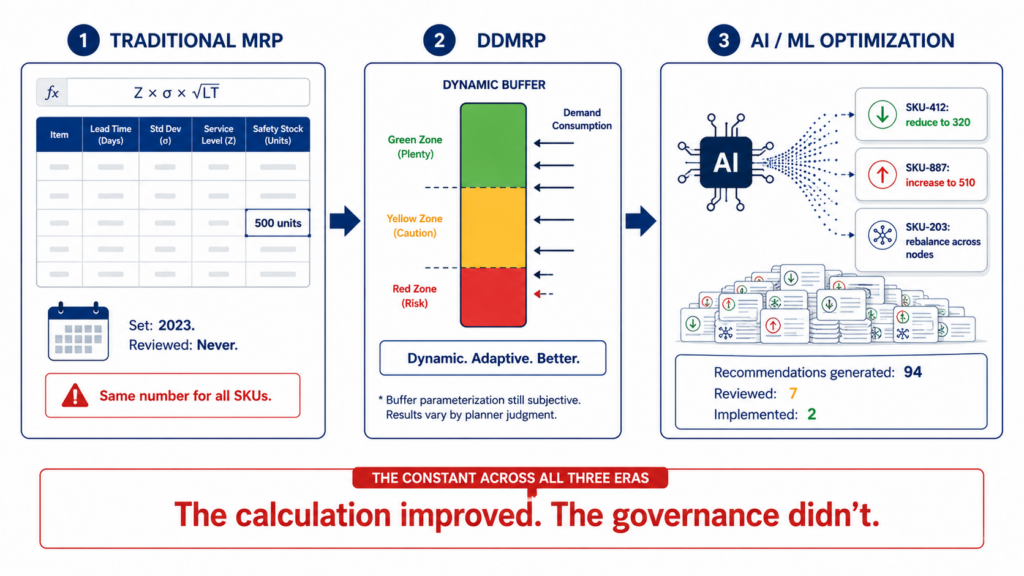
This is where the conversation gets uncomfortable. Because the industry hasn’t been standing still. Two major approaches have emerged to solve exactly this problem. Neither has fully delivered.
DDMRP promised dynamic buffers.
Demand Driven MRP replaced the static safety stock concept with strategically positioned decoupling buffers — red, yellow, and green zones that adapt to actual demand consumption rather than forecast-driven replenishment. The theory is sound. DDMRP buffers act as both a gauge and an alert system, while traditional safety stock only tells you when you’re already in trouble. Implementations have shown real results — 15–30% inventory reductions within weeks at some organizations, according to practitioners.
But DDMRP isn’t universally adopted, and where it is, challenges remain. A 2025 academic simulation study found that DDMRP’s buffer parameterization still involves subjective choices that raise concerns about consistency and performance. The red zone safety stock calculation can vary significantly depending on planner judgment. And as Brightwork Research points out, if traditional safety stock were truly solving the problem, organizations wouldn’t face stockouts even with buffers in place — yet they do, under both traditional MRP and DDMRP, because the underlying governance problem persists.
AI and ML promised autonomous optimization.
In 2026, 68% of retailers plan to use AI for inventory management — the most popular AI use case in retail, according to NRF. Deloitte’s April 2026 research describes autonomous Inventory Agents that continuously optimize safety stock at the part level. IBM’s 2026 framework places AI agents across demand, inventory, production, and logistics. The technology to dynamically calculate the right buffer at SKU level, continuously, in real time — exists.
And yet:
- AI-recommended safety stock adjustments get generated but sit in a queue — nobody reviews them until the next quarterly business review
- Multi-echelon optimization tools calculate theoretically optimal stock positions across the network — planners override them with manual buffers because they don’t trust the output
- The forecast gets smarter every year. The buffer that’s supposed to respond to it stays frozen at whatever someone entered 18 months ago
The pattern is the same for both DDMRP and AI: the methodology or technology advances, but the organizational muscle to continuously review, challenge, and update buffer parameters doesn’t follow.
THE CASCADE NOBODY CONNECTS
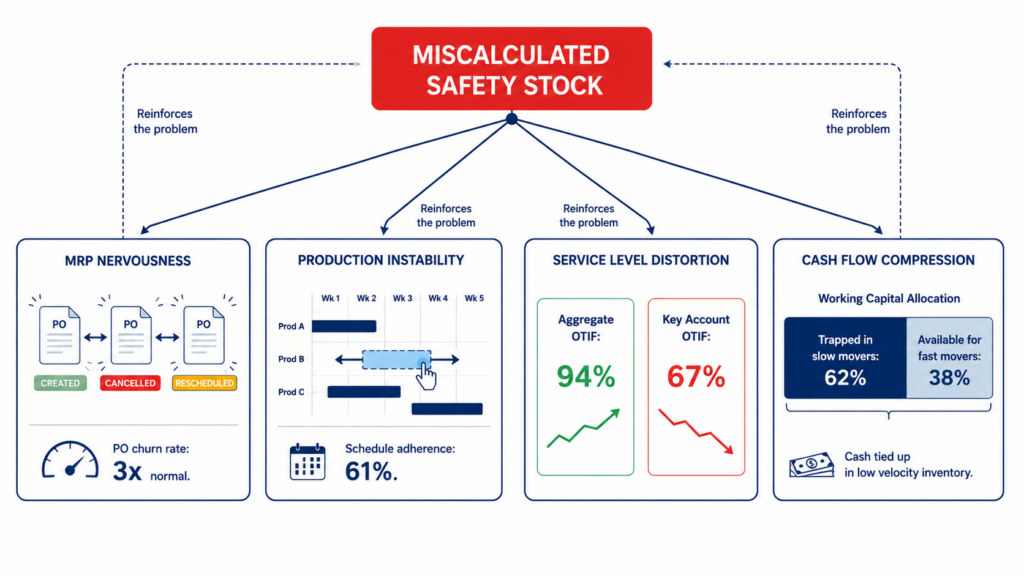
Miscalculated safety stock doesn’t stay contained. It cascades through the entire planning chain.
- MRP nervousness — tight buffers trigger constant reorder signals with every minor demand shift. Purchase orders churn. Suppliers get whiplash from reschedules. Planners manage noise instead of real exceptions.
- Production instability — wrong buffers mean wrong timing. Overproducing to rebuild stock that didn’t need rebuilding, or scrambling to expedite when a real shortage hits because the buffer was too thin where it mattered.
- Service level distortion — aggregate metrics look healthy while specific high-value customers experience stockouts on critical SKUs. The average hides the damage.
- Cash flow compression — excess buffer on slow movers traps working capital that should fund procurement for fast movers. Research on MRO inventory shows 30–50% of parts haven’t moved in 24 months. Nobody connects the cash flow problem to a safety stock parameter that hasn’t been touched in a year.
THIS IS THE PROBLEM OPTIFLOWAI EXISTS TO SOLVE
The supply chain industry has spent decades refining how safety stock is calculated — better formulas, smarter algorithms, dynamic buffers, autonomous agents. The math keeps getting better. The outcomes haven’t kept pace.
Because the problem was never the calculation. It was what happens after the calculation — who sees it, who challenges it, who owns the decision, and how fast the plan adapts when the number is no longer right.
That’s the gap OptiFlowAI is built around. Safety stock sits inside the production plan — alongside demand, capacity, and inventory — so every planning review naturally includes a buffer check. Breaches surface in real time, giving planners the window to respond before downstream impact compounds. And as conditions shift, the planning rhythm absorbs the change — connecting the buffer decision directly to the procurement and production actions it affects.
The goal isn’t just a smarter number. It’s a tighter loop between the number and the action it triggers — managed with the same rigor the industry already applies to demand plans and production schedules.
The most expensive safety stock isn’t the one that’s too high or too low. It’s the one nobody’s looked at — regardless of how intelligent the system that calculated it claims to be.x`