
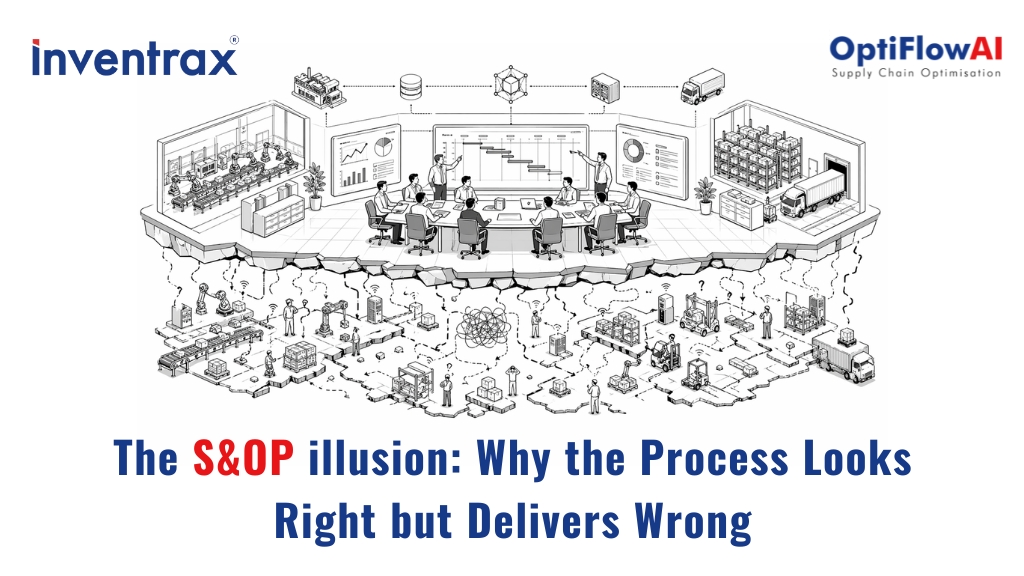
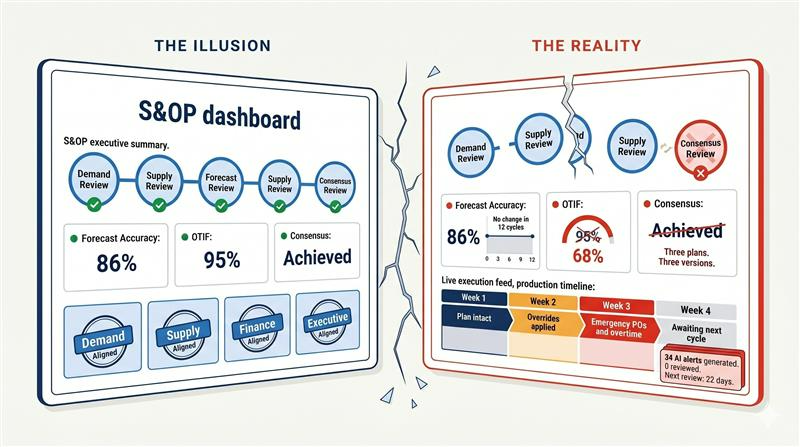
On paper, the S&OP process looks healthy. Monthly meetings happen on schedule. Demand and supply teams present their numbers. Leadership reviews the plan, nods in agreement, and the cycle closes. Check the box S&OP is running.
Except it isn’t. Not really.
What most organizations call S&OP is a well-rehearsed performance a process that looks like alignment but delivers fragmentation. The meetings happen, the slides get presented, but the decisions either don’t get made, don’t stick, or don’t translate into what actually happens on the ground. This is the S&OP illusion and it’s more common than anyone wants to admit.
The numbers confirm it. A 2026 Blue Ridge Global study surveying 230 supply chain leaders found a widening disconnect between rising technology investment and actual supply chain performance improvement. Most organizations reported forecast accuracy stuck in the 81–90% range improving, but plateauing well before it drives meaningful change in service, inventory, or cost outcomes. The tools are getting smarter. The process isn’t keeping up.
ILLUSION #1: THE MATURITY THAT ISN’T THERE
Most S&OP processes operate at a basic level disguised as maturity. Teams collect data, build forecasts, run a supply review, and hold an executive meeting. The cadence exists. The depth doesn’t.
- Demand plans are built on historical averages with minimal market intelligence or customer-level input.
- Supply reviews check capacity at an aggregate level but never stress-test against realistic disruption scenarios.
- Financial integration is either absent or treated as a parallel exercise that never truly connects to the operational plan.
- KPIs are reported but never trigger corrections, forecast accuracy can miss consistently for months without anyone questioning the model, the inputs, or the process behind it.
Industry research consistently shows that roughly a third of supply chain planning leaders identify ineffective decision-making during S&OP meetings as the single most critical problem in their function. The meetings happen. The decisions don’t. And yet the organization believes it has a functioning S&OP because the calendar says so.
The process follows the textbook steps. But without scenario depth, constraint-level rigor, and financial linkage, it’s S&OP in name only.
ILLUSION #2: AI ADOPTION WITHOUT PROCESS CHANGE
The supply chain industry is pouring money into AI. According to Forbes, 75% of companies’ priority investments globally are now focused on artificial intelligence. Demand sensing, predictive analytics, automated forecasting the technology is landing. But in most organizations, it’s landing on top of the same broken process.
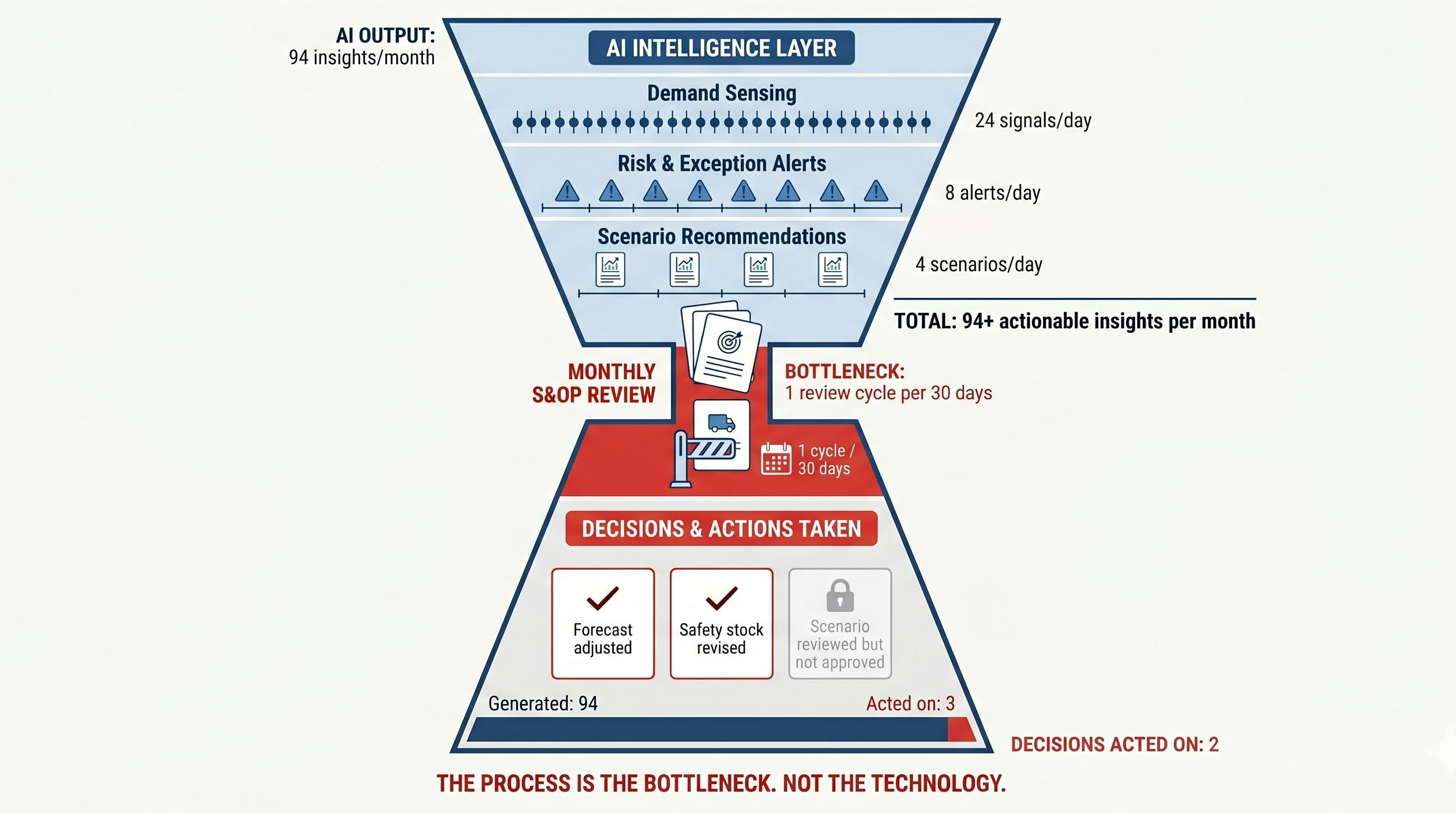
- AI-generated forecasts feed into the same monthly S&OP cycle that was too slow before AI arrived
- Machine learning identifies demand signals in real time, but the planning cadence only reviews them every 30 days
- Advanced algorithms surface exceptions and risks, but nobody has redesigned the decision workflow to act on them faster
- The organization announces an “AI-powered S&OP transformation” while the executive review meeting still runs on the same static slide deck it used three years ago
The 2026 Blue Ridge study captures this reality organizations are modernizing and adopting new technologies, but improvements in forecast accuracy, service levels, and inventory efficiency remain incremental rather than transformational. The technology isn’t the constraint. The process wrapped around it is.
AI without process redesign is like putting a jet engine on a bicycle. The power is there. The frame can’t handle it. And the S&OP illusion deepens because now leadership believes the process is not just running, but running on AI. The label changed. The outcomes didn’t.
ILLUSION #3: A PLAN THAT STOPS AT THE PLANNING FENCE
Even when the S&OP plan is solid, most organizations have no mechanism to connect it to what happens next. The monthly plan gets approved, and then execution operates on a completely different rhythm daily firefighting, weekly scheduling adjustments, ad hoc allocation changes with no feedback loop to the plan it’s supposed to follow.
- The gap between S&OP and S&OE is where plans go to die
- By week two, the approved plan is already obsolete but nobody formally revises it until the next monthly cycle
- Execution teams make real-time trade-offs that contradict the strategic intent of the plan, because the plan doesn’t travel with them
- Post-cycle reviews rarely ask “why did execution deviate?” they just reset and start a new plan
The same Blue Ridge study found that only 23% of organizations continuously update their forecasts the rest still rely on monthly or quarterly planning cycles. SAP’s 2026 supply chain outlook echoes this, noting that traditional planning cadences monthly S&OP, weekly supply planning, daily scheduling are increasingly misaligned with the pace of real-world volatility. And according to Clarkston Consulting’s 2026 trends analysis, AI investment is now shifting rapidly from planning-only applications into execution real-time inventory rebalancing, dynamic scheduling, and automated exception management. The industry is recognizing that planning intelligence without execution connectivity is a ceiling, not a foundation.
HOW OPTIFLOWAI BREAKS THE PATTERN
OptiFlowAI is designed to expose and eliminate every layer of the S&OP illusion.
- Maturity gaps become visible. OptiFlowAI enforces scenario-tested planning no plan gets finalized without being stress-tested against demand variability, supply constraints, and capacity trade-offs. Surface-level reviews are replaced with constraint-aware, data-backed decisions.
- AI meets the right process. OptiFlowAI doesn’t just add intelligence to an outdated cadence. It restructures how AI-generated insights flow into decisions continuous scenario refresh, real-time constraint evaluation, and event-driven replanning that matches the speed of the signals AI produces. The engine and the frame are built together.
- Planning connects to execution. OptiFlowAI doesn’t stop at the monthly plan. As conditions change, the plan updates continuously feeding revised signals into scheduling, procurement, and inventory decisions in real time. The gap between S&OP and S&OE closes because the plan stays alive beyond the meeting room.
The S&OP illusion persists because it’s comfortable. The meetings feel productive. The reports look polished. But OptiFlowAI forces the uncomfortable question is your process delivering results, or just delivering slides?
OptiFlowAI doesn’t just fix S&OP. It makes it honest.